
How to Evict a Tenant in NY
for Nonpayment of Rent
Nassau County, NY – Suffolk County, NY
How to Evict a Tenant for Nonpayment of Rent in New York
There are generally two types of eviction proceedings available to landlords: a nonpayment proceeding and a holdover proceeding. A nonpayment proceeding is an eviction proceeding where the landlord seeks to evict the tenant based on the tenant’s failure to pay rent. A holdover eviction is brought to remove every other type of person who needs to be removed from possession of real property, regardless of whether they come up with the rent or not.
If your tenant stopped paying the rent, you most likely will want to bring a nonpayment proceeding to evict your tenant. But in some scenarios, a holdover eviction is also an available option, and the landlord must choose which one is best for their situation.
Your tenant stopped paying. You need them out. Here’s how the nonpayment eviction process works in Nassau County and Suffolk County — and what you need to know before you start.
We’re an evictions-only law firm serving Nassau and Suffolk County. We handle nonpayment proceedings every day. One flat fee covers everything through trial. Call or text (631) 888-6989 for a free consultation.
Nonpayment vs. Holdover: Which Proceeding Do You Need?
There are two types of eviction proceedings in New York: a nonpayment proceeding and a holdover proceeding. If your tenant stopped paying rent, you’re probably thinking nonpayment. But read this section before you decide — because in some situations, a holdover proceeding is the smarter move.
A nonpayment proceeding is faster. It’s designed specifically for unpaid rent, and it can resolve more quickly than a holdover. The catch: if your tenant shows up to court with all the back rent in hand at any point during the proceeding, your petition gets dismissed. The case ends. You can’t evict them — at least not on nonpayment grounds.
A holdover proceeding takes slightly longer because it requires a longer predicate notice. But it has a significant advantage:
In a holdover proceeding, even if the tenant shows up to court with all the back rent owed, you can accept the money AND still evict the tenant.
So if your tenant is difficult, has a history of paying late then catching up at the last minute, or if you simply want them gone regardless of whether they pay — a holdover may be the right call even though rent is the presenting issue.
Not sure which one fits your situation? That’s a free phone call. We’ll help you decide.
Before You Can File: The Prerequisites
To bring a nonpayment proceeding in New York, you must meet these requirements:
You must be the owner of the property. The person you’re evicting must be a tenant in actual possession. If the property is a one-family house, there can be no more than two residential units.
You also need to know what type of tenancy you’re dealing with — written lease, oral month-to-month, or at-will — because the type of tenancy affects whether any additional notice requirements in the lease itself must be satisfied before you can start.
Two additional rules specific to nonpayment proceedings:
The money you’re seeking must be actual back rent. You cannot include money for repairs, damages, or other charges unless they’re specifically defined as additional rent in a written lease.
You can only collect rent that came due within the past six months. This is called the doctrine of laches — think of it as a statute of limitations on back rent. Rent older than six months is considered stale, and the court will not award it. If your tenant has been behind for a long time, don’t wait any longer.
Step 1: Serve the Required Notices
Every eviction proceeding in New York requires a predicate notice — a formal notice that must be properly served on the tenant before you can file in court. For a nonpayment proceeding, two notices are required.
The 5-day certified mail notice. Once rent is at least 5 days past due, you must send the tenant written notice by certified mail and first-class mail stating that the rent is overdue and specifying the total amount owed. This notice makes no demand — it’s purely informational, and it’s a required precursor to the 14-day demand.
The 14-day rent demand notice. This is the formal demand. It tells the tenant to pay all back rent in full or vacate within 14 days. If the tenant does neither, you can proceed to court.
The 14-day notice must be served the same way as a court petition — by a process server who is over 18, lives in New York, and is not a party to the action. You cannot serve it yourself. Strict compliance with the service requirements is mandatory. A defect in how the notice was served will get your case dismissed.
Step 2: File the Petition
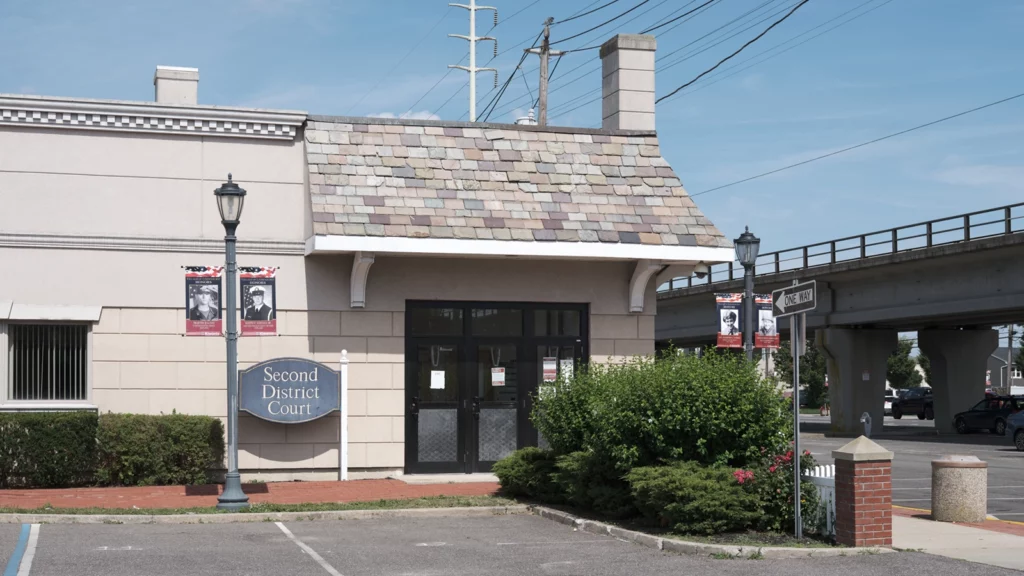
Once the 14-day notice period expires without payment or vacatur, you file a Notice of Petition and Nonpayment Petition with the appropriate court — Nassau County District Court in Hempstead for Nassau County properties, or the relevant Suffolk County District Court for Suffolk County properties.
Before filing, you must call the court’s landlord-tenant unit to select a hearing date. That date must appear on the notice of petition and must be at least 17 days in the future. The filing fee is $45, called an index fee. The clerk returns your time-stamped copy with a receipt.
Step 3: Serve the Petition on the Tenant
A process server must serve the petition and all required statutory notices on the tenant. Service must happen no more than 17 days before the hearing date and no less than 10 days before it. An affidavit of service must then be filed with the court clerk within the time required by law.
Step 4: Appear in Court
On the hearing date, your attorney appears before the landlord-tenant judge.
If the tenant doesn’t show, your attorney requests a default judgment — provided the petition and notices were properly drafted and served with no defects. This is why technical accuracy in the earlier steps matters so much.
If the tenant appears, the judge will direct both sides to step out and attempt a settlement. Many nonpayment cases resolve at this stage through a stipulation of settlement — typically an agreement where the tenant pays the back rent by a set date in exchange for remaining in the property, or agrees to vacate by a specific date.
If a stipulation is entered, the language in that agreement matters. A well-drafted stipulation includes immediate remedy language so that if the tenant fails to comply, you don’t have to return to court for enforcement. This is one of the details that separates experienced eviction attorneys from lawyers who handle these cases occasionally.
If no settlement is reached, the judge schedules a trial.
Step 5: Trial
At trial, you testify first as the landlord-petitioner. You must establish the facts needed to prove nonpayment — the tenancy, the rent amount, and the failure to pay. If you fail to state everything required, the petition gets dismissed.
The tenant then presents any defenses. If the tenant has no valid defenses and cannot show the rent has been paid, you can expect a monetary judgment for the back rent, a judgment of possession, and a warrant of eviction that allows the sheriff to physically remove the tenant.
Timeline: How Long Does This Take?
As a general guide, an uncontested nonpayment case typically resolves within these ranges from the time we’re retained:
Suffolk County District Courts: roughly 30 to 45 days. Nassau County District Court: roughly 45 to 60 days. Town Justice Courts on the East End: roughly 30 days. Add at least two weeks for any unforeseen delays.
Most cases settle before trial, which means they often resolve faster than the maximums above. Cases that go to trial take longer. If you want a timeline specific to your situation, ask us on the free call.
Why It Matters Who Handles This
Nonpayment proceedings in New York are procedurally precise. The notices, the service, the petition, the stipulation language — each step has requirements that, if missed, reset the clock. Meanwhile, tenants in Nassau and Suffolk County increasingly have access to free legal representation through Legal Services of Long Island, which means you may face an attorney on the other side who handles these cases exclusively.
We handle evictions exclusively too. One flat fee. No charges per appearance. No surprise bills if your tenant contests the case or requests adjournments. We start within 24 to 48 hours of being retained.
Call or Text
Have Questions? Speak with Us For Free.
We offer free consultations via phone, text or chat. Don't wonder about what your rights are or what your next move is. Call and find out.
📞 (631) 888-6989💬 Text Us NowOTHER TYPES OF EVICTIONS:
RELATED ARTICLES:






Summary of the timeline to evict a tenant in Nassau County & Suffolk County
Step 1
Drafting & serving required notices
The required predicate notices must be drafted and sent to a process server for service. Service could take a week or more.
Step 2
Wait for notice expiration
After service is completed, you must wait for the expiration of the time period on the notice to proceed. It could be a 10-day notice, a 14-day notice, a 30-day notice, a 60-day notice, or a 90-day notice, depending on your situation. This is the time that the tenant has to pack up and leave.
Step 3
Asses status
After the time on the notice expires, if the tenant still has not moved out, you can now proceed with a court proceeding to have them legally removed.
Step 4
Draft & File Petition & Receive Court Date
Upon immediate conclusion of the notice period, a notice of petition and petition will be filed with the court to begin the eviction proceeding. The court assigns a court date. As soon as the attorney knows the date, the client will be notified and given additional instructions, like what to do on the court date and what to expect.
Step 5
Serve Tenants with the Petition & Notices
The tenant must be served again with the petition and required legal notices, and will be notified to appear in court on the appearance date.
Step 6
Appear in Court
On the court date, all parties will appear in court. If the tenant fails to appear, the landlord’s attorney may ask the court for a judgment of possession and a warrant of eviction by default. If all parties are present, they will be expected to have a conference in the courthouse to discuss the possibility of settlement.
If the case can be settled, the parties will draft a stipulation of settlement, which will describe what they have agreed to. If the judge approves the settlement, the case will be over.
Step 7
Trial
If the parties cannot come to settlement terms, then the judge will schedule a trial on a new date. On the day of trial, both sides will present their case. If your tenant loses, the court will issue a judgment of possession and a warrant of eviction, which is what the Sheriff will need to physically remove your tenant.
Step 8
Have Your Tenants Physically Removed
You can now take your judgment and warrant to your county sheriff, and they will physically remove your tenant and their belongings from the apartment, and return possession of the premises back to you.
- Get the free guide
Is this you?
want our free guide?
Subscribe to our newsletter & make sure you’re not making the same mistakes.
Learn More About Nonpayment Proceedings:

New York Eviction Notices: What to Serve and When
New York Eviction Notices: Which One Do You Need? Before you can...
Read More
Types of Eviction Proceedings in New York State
Types of Eviction Proceedings in New York State Tenant Eviction Process in...
Read More
What’s the Penalty for Renting an Illegal Apartment?
Renting an illegal apartment can lead to serious consequences, but it may...
Read MoreBuilding Trust and Bringing Results for Over 15 Years
Our lawyers have helped thousands of Long Island landlords find piece of mind and evict their problem tenants quickly and efficiently.
"They were very pleasant and prompt, and always returned phone calls in a timely manner. The lawyer was very helpful and patient with us.”

